Showing posts with label Rainbow Bee-eater. Show all posts

Sunday, 14 February 2016

February

The first two banding sessions for February were not as dazzling as January when we were processing 100 birds a morning, however over 30 birds on both mornings was not a disappointing catch.

Nets in the reed bed produced Australian Reed-warblers and most of the other birds came from nets in the grove. The large flocks of Silvereyes seem to have passed through and now Striated Pardalote and Willie Wagtail numbers match the Silvereyes.

One first-year Willie Wagtail had unusual primary moult where it had replaced primaries 5 and 7, and was in the process of replacing P3, but the rest were old feathers. Very different to the usual inside-to-outside, sequential pattern you usually see in passerines.

Willie Wagtail primary moult.

 A flock of 50+ Rainbow Bee-eaters was hanging around but hesitant to come low enough for our nets. Finally there was a surprise reappearance by the White-browed Scrubwren we banded a few weeks ago.

First-year Yellow-rumped Thornbill.


6 Feb 2016
Species - New (retrap)
Australian Reed-warbler - 3
New Holland Honeyeater - 1
Silvereye - 11 (1)
Striated Pardalote - 6
Western Gerygone - 1
Willie Wagtail - 5 (3)
Yellow-rumped Thornbill - (1)
Total - 27 (5) = 32

13 Feb 2016
Species - New (retrap)
Australian Reed-warbler - 4
Grey Fantail - 2
Rainbow Bee-eater - 1
Rufous Whistler - 1 (1)
Silvereye - 5 (2)
Striated Pardalote - 6
Western Gerygone - 2 (1)
White-browed Scrubwren - (1)
Willie Wagtail - 8 (3)
Yellow-rumped Thornbill - (1)
Total - 29 (9) = 38

Monday, 1 February 2016

January Wrap-up

Saturday the 30th was the last banding day for January this year, and an excellent month it was. The total catch for the month was 363 birds, only 16 short of the January record.

On the 30th we managed to just crack the 100 bird mark with 103 birds processed, comprised mostly of Silvereyes and Striated Pardalotes. Once again the vast majority of Silvereyes were in their first year and the pardalotes were the same. These birds all came out of six nets, as Settler's Cottage was being used during the morning and we were exiled to the Grove. Two Australian Reed-warblers were also caught, a nice surprise outside of the reed-bed, as well as two juvenile Rainbow Bee-eaters.

We caught a single male Variegated Fairy-wren which was a retrap. Interestingly it was first banded on the same day as last week's female Variegated Fairy-wren retrap, 7th July 2012.

Male Variegated Fairy-wren

Species - New (retrap) [control]
Australian Reed-warbler - 2
Grey Fantail - 1
New Holland Honeyeater - 1
Rainbow Bee-eater - 2
Silvereye - 60 (2) [1]
Striated Pardalote - 25
Variegated Fairy-wren - (1)
Western Gerygone - 1
Willie Wagtail - 1 (4)
Yellow-rumped Thornbill - 1 (1)
Total - 94 (8) [1] = 103

Saturday, 23 January 2016

More Than Just a Hobby

16th of January: Another hot day with an early finish, however this didn't seem to deter the birds. Tree Martins were flying low in large flocks and we managed to get 20 of these gorgeous birds in the mound nets, as well as an Australian Hobby later in the morning! Other than the martins, numbers were fairly low compared to recent weeks however it all averaged out to a good catch of 48 as we had a staggering 16 species.
Other highlights were Shining Bronze-cuckoo, Rainbow Bee-eater juveniles, Grey Teal and Laughing Kookaburra. Surprisingly we only caught 4 Silvereyes.

Australian Hobby

Species - New (retrap)
Australian Hobby - 1
Brown Honeyeater - 1
Grey Teal - 2
Laughing Kookaburra - 1
Pacific Black Duck - 1
Rainbow Bee-eater - 3
Red Wattlebird - 1
Rufous Whistler - 3
Sacred Kingfisher - 2
Shining Bronze-cuckoo - 1
Silvereye - 2 (2)
Striated Pardalote - 2 (1)
Tree Martin - 20
Western Gerygone - (1)
Willie Wagtail - 3
Yellow-rumped Thornbill - (1)
 Total - 43 (5) = 48

Saturday, 9 January 2016

First banding of 2016

Despite high temperatures, the first couple of banding sessions of 2016 (6 and 9 January) were excellent. Silvereyes are starting to move through again and most of these are first-year birds. We are getting very few recaptures of the Silvereyes that were resident during Oct-Nov last year.

On Wednesday the 6th we caught 25 birds including Grey Teal, Sacred Kingfisher and Tree Martin. A young Horsfield's Bronze-cuckoo (the first since 2013) was the highlight.

Juvenile Horsfield's Bronze-cuckoo showing the dark ear-stripe and rufous tail.
Horsfield's Bronze-cuckoo

Species - New (retrap)
Brown Honeyeater - (1)
Grey Teal - 2
Horsfield's Bronze-cuckoo - 1
Laughing Dove - 1 (1)
Pacific Black Duck - 1 (1)
Rufous Whistler - (1)
Sacred Kingfisher - (1)
Silvereye - 5 (1)
Singing Honeyeater - 4
Tree Martin - 1
Willie Wagtail - 3
Yellow-rumped Thornbill - 1
Total - 19 (6) = 25


On Saturday the 9th we had more banders available and were able to put up more nets, resulting in a catch of 54 birds! Of particular significance was the Herdsman Lake project's first ever Australasian Darter, which flew into a large-mesh net across the drain. White-winged Triller, Laughing Kookaburra, Grey Teal and Rainbow Bee-eater were also among the 13 species caught on Saturday.
The Silvereye movement was obvious here with only one retrap among 35 new birds. The retrap was from the previous banding session.

White-winged Triller
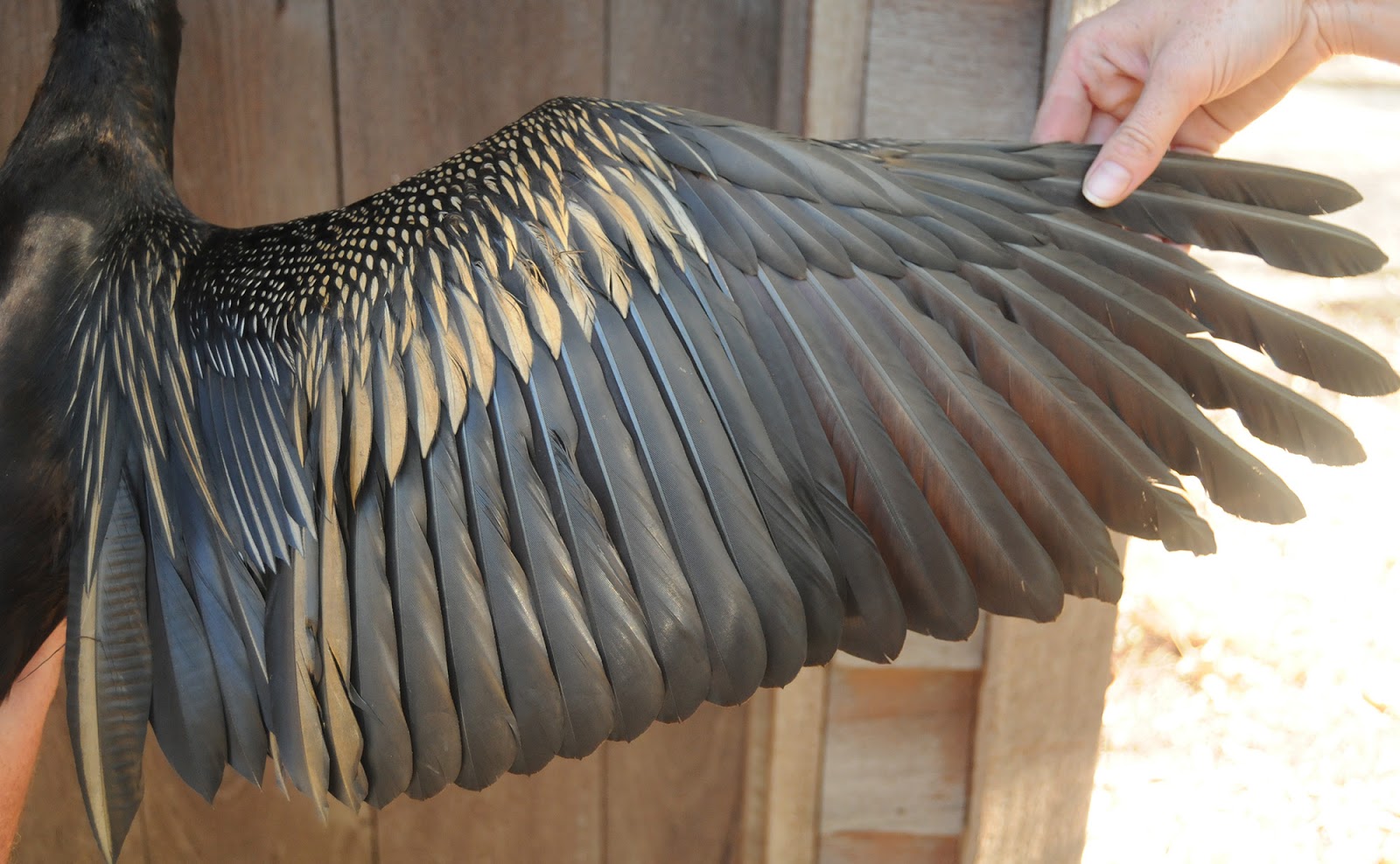
Australasian Darter. A gentle but firm hold on the birds head is necessary to keep that stunningly sharp bill away from the bander.
Australasian Darter
Close-up of the wing. Interesting to see the corrugated shape of the very long scapular feathers.


Species - New (retrap)
Australasian Darter - 1
Brown Honeyeater - 3
Grey Teal - (1)
Laughing Kookaburra - 1
New Holland Honeyeater - 1
Pacific Black Duck - 1 (1)
Rainbow Bee-eater - 1
Silvereye - 35 (1)
Tree Martin - 1
Weebill - 1
Western Gerygone - 1 (1)
White-winged Triller - 1
Willie Wagtail - 2 (1)
Total - 49 (5) = 54

Monday, 2 November 2015

Churchlands Primary School Banding Demonstration


We had a great day on Wednesday giving a banding demonstration to the Pre-Primary and Kindy kids of Churchlands Primary School. As the school is right across the road from Herdsman Lake this was a fantastic opportunity for the kids to learn about the birds in their local environment and the importance of Herdsman Lake in the Perth area, as well as see some of the smaller bush birds up close. We managed to catch a Silvereye, Yellow-rumped Thornbill and New Holland Honeyeater to show which the kids loved. A large focus of the talk was on working scientifically. The classes learned about the aims of the Australian Bird and Bat Banding Scheme and we showed how we conduct our research at the lake by applying a band to the bird's leg and demonstrating how we take all the measurements and record data. Some lucky kids even got the chance to help release a bird back into the bush. The day was a success all round, and hopefully we inspired some budding ornithologists to grab some binoculars and get out there!

Showing the wing and moult
of a New Holland Honeyeater

Too big for a Honeyeater - showing the
different sizes of bands

Releasing a Silvereye

Photos: Calan Rance


"Dear Lizzie, Thankyou for showing
nearly all the birds, and we saw a
 Bee-eater hole and for teaching
...how to measure its fat
."
"Dear Lizzie, Thankyou for showing us the birds
they are so cute and looked so cuddly.
I like the Silvereye bird the most. I also
 loved when you measured its head
."

Earlier in the morning before the classes arrived we still conducted a normal banding session and had a slow but steady October catch. The highlight of the morning was another Bee-eater (with interesting tail moult leading us to age it as a 2-), which was unfortunately just that bit too early for the kids to see.

Tail of a 2- Rainbow Bee-eater

Breakdown  28/10/2015:

Silvereye: 4 new, 7 retraps
Singing Honeyeater: 1 new
New Holland Honeyeater: 1 new
Yellow-rumped Thornbill: 2 new, 1 retraps
Rainbow Bee-eater: 1 new
Laughing Dove: 1 retrap
TOTAL: 9 new + 9 retrap = 18


Saturday, 24 October 2015

Magpie-lark makes a rare appearance

October continues to delight! The weather was wonderful this weekend; overcast with mild temperatures and barely any wind. The good conditions were reflected in the 48 birds of 15 different species that were caught during the morning.

Red Wattlebirds were once again plentiful, along with Brown and New Holland Honeyeaters around the bottlebrush trees. Sadly the bottlebrushes look like they will finish flowering very soon. Two of the day's highlights were caught here; a Galah and a Magpie-lark! Magpie-lark hasn't been caught at Herdsman in the last three years.

An exciting recapture came in the form of an adult Red Wattlebird, originally banded in April 2009 - an elapsed time of six years and six months.

We caught four Rainbow Bee-eaters, which are starting to build their nest burrows in sandy patches around the area. The one female that we caught had only the beginning of a brood patch, hinting that the nest building was quite recent.

The Grove nets were set up as it was finally dry in there after months of being a knee-deep swamp. Two of the Bee-eaters were caught there, as well as Shining Bronze-cuckoo and a brilliant Splendid Fairy-wren. The wren is another species we rarely catch at Herdsman, the last time being over three years ago.

Singing Honeyeater juvenile
Red Wattlebird
Willie Wagtail juvenile
The star of the day - adult male Magpie-lark
Species - new (retrap)
Brown Honeyeater - 4
Galah - 1
Laughing Dove - 1
Magpie-lark - 1
New Holland Honeyeater - 3 (2)
Rainbow Bee-eater - 4
Red Wattlebird - 5 (1)
Rufous Whistler - (1)
Shining Bronze-cuckoo - 1
Silvereye - 3 (9)
Singing Honeyeater - 1
Splendid Fairy-wren - 1
Striated Pardalote - 6 (1)
Willie Wagtail - 2
Yellow-rumped Thornbill - 1
Total - 34 (14) = 48

Saturday, 10 October 2015

Bee-eaters have arrived

24 birds of 10 species was a reasonably good catch for an October morning. The wind (or rather the lack of) was on our side however it got hot quickly in the sunny weather. The bottlebrush trees in the car park were bursting with flowers so that site was particularly good for catching honeyeaters.

Brood patches were obvious and plentiful particularly in Silvereyes and honeyeaters.
The highlight was a male and a female Rainbow Bee-eater caught together in the car park net. These were the first bee-eaters netted for the season, newly arrived from the north in preparation for breeding - we first saw them at Herdsman the week before.

Male Rainbow Bee-eater

Yellow-rumped Thornbill (photo by Lizzy)

Species - new (retrap)
Brown Honeyeater - 3
New Holland Honeyeater - 1
Rainbow Bee-eater - 2
Rufous Whistler - 1 (1)
Silvereye - 2 (7)
Singing Honeyeater - (1)
Striated Pardalote - 2 (1)
Western Gerygone - 1
Willie Wagtail - 1
Yellow-rumped Thornbill - (1) 
Total - 13 (11) = 24