Monday, 14 March 2016

Mid-March Mist-netting

12 March 2016
We had enough people to run a good variety of nets this weekend and this gave us a diverse catch. The highlights were four first-year Black-faced Cuckooshrikes in the same net. This is a rather spectacular figure given that the previous total banded was just 11 over 15 years at Herdsman!

First-year Black-faced Cuckooshrike
A trio of Black-faced Cuckooshrikes

Silvereyes and Striated Pardalotes were both present in good numbers. The pardalotes were all first-year birds and most of the Silvereyes that we were able to age were also first-years.


The Inland Thornbill we caught recently was recaptured this weekend in the same area.

Inland Thornbill
Adult (age 2+) Australian Reed-warbler
 
Species - new (retrap)
Australian Reed-warbler - 2
Black-faced Cuckooshrike - 4
Brown Honeyeater - 1
Grey Teal - 1
Inland Thornbill - (1)
Pacific Black Duck - (2)
Rufous Whistler - 1
Silvereye - 19 (1)
Singing Honeyeater - 1
Striated Pardalote - 15
Western Gerygone - 1 (1)
Willie Wagtail - 3 (1)
Total - 48 (6) = 54

Monday, 7 March 2016

Breaking Records in February

Apologies for the lack of recent posts. Here are the last three weeks of banding at Herdsman!

20 Feb 2016
This weekend was rather slow and we only processed four species during the Saturday morning. Surprise numbers of Striated Pardalotes made up for the low numbers of Silvereyes.

Species - New (retrap)
Pacific Black Duck - 1 (1)
Silvereye - 6
Striated Pardalote - 12
Willie Wagtail - 2 (1)
Total - 21 (2) = 23


27 Feb 2016
This Saturday made for an exciting February banding session. We caught good numbers of Silvereyes including 10 recaptures. Many of the Silvereyes first caught in December/January in juvenile plumage are now moulting or have finished moulting into adult dress and are difficult to distinguish from older birds.
A smattering of Australian Reed-warblers was a welcome addition, as was an Inland Thornbill, only the third ever for the Herdsman project.

On another note, for the first time ever the catch exceeded 1000 birds before March (our 'banding year' starts in July and runs until the end of the following June). The total came to 1028 birds on our last banding session for February.

Species - New (retrap)
Australian Reed-warbler - 6
Brown Honeyeater - 1
Inland Thornbill - 1
Pacific Black Duck - 1
Rufous Whistler - 3
Silvereye - 18 (10)
Singing Honeyeater - (1)
Striated Pardalote - 9
Western Gerygone - (1)
Total - 39 (12) =51


5 Mar 2016
Birds were not particularly numerous this weekend (not unusual for the time of year) however we did have a particularly diverse catch this time. 19 birds of an amazing 12 species were processed, highlights being an Australian Magpie, Australian Raven and Magpie-lark which all came from the same net.
Silvereyes were few and far between but we caught a variety of honeyeaters, which have been notable in their absence recently.

Adult Australian Raven
Adult female Australian Magpie
Species - New (retrap)
Australian Magpie - 1
Australian Raven - 1
Brown Honeyeater - 2
Laughing Dove - 1
Magpie-lark - 1
Red Wattlebird - (1)
Silvereye - (2)
Singing Honeyeater - 1
Striated Pardalote - 1
Western Gerygone - 2
Willie Wagtail - 2 (1)
Yellow-rumped Thornbill - (3)
Total - 12 (7) = 19

Sunday, 14 February 2016

February

The first two banding sessions for February were not as dazzling as January when we were processing 100 birds a morning, however over 30 birds on both mornings was not a disappointing catch.

Nets in the reed bed produced Australian Reed-warblers and most of the other birds came from nets in the grove. The large flocks of Silvereyes seem to have passed through and now Striated Pardalote and Willie Wagtail numbers match the Silvereyes.

One first-year Willie Wagtail had unusual primary moult where it had replaced primaries 5 and 7, and was in the process of replacing P3, but the rest were old feathers. Very different to the usual inside-to-outside, sequential pattern you usually see in passerines.

Willie Wagtail primary moult.

 A flock of 50+ Rainbow Bee-eaters was hanging around but hesitant to come low enough for our nets. Finally there was a surprise reappearance by the White-browed Scrubwren we banded a few weeks ago.

First-year Yellow-rumped Thornbill.


6 Feb 2016
Species - New (retrap)
Australian Reed-warbler - 3
New Holland Honeyeater - 1
Silvereye - 11 (1)
Striated Pardalote - 6
Western Gerygone - 1
Willie Wagtail - 5 (3)
Yellow-rumped Thornbill - (1)
Total - 27 (5) = 32

13 Feb 2016
Species - New (retrap)
Australian Reed-warbler - 4
Grey Fantail - 2
Rainbow Bee-eater - 1
Rufous Whistler - 1 (1)
Silvereye - 5 (2)
Striated Pardalote - 6
Western Gerygone - 2 (1)
White-browed Scrubwren - (1)
Willie Wagtail - 8 (3)
Yellow-rumped Thornbill - (1)
Total - 29 (9) = 38

Monday, 1 February 2016

January Wrap-up

Saturday the 30th was the last banding day for January this year, and an excellent month it was. The total catch for the month was 363 birds, only 16 short of the January record.

On the 30th we managed to just crack the 100 bird mark with 103 birds processed, comprised mostly of Silvereyes and Striated Pardalotes. Once again the vast majority of Silvereyes were in their first year and the pardalotes were the same. These birds all came out of six nets, as Settler's Cottage was being used during the morning and we were exiled to the Grove. Two Australian Reed-warblers were also caught, a nice surprise outside of the reed-bed, as well as two juvenile Rainbow Bee-eaters.

We caught a single male Variegated Fairy-wren which was a retrap. Interestingly it was first banded on the same day as last week's female Variegated Fairy-wren retrap, 7th July 2012.

Male Variegated Fairy-wren

Species - New (retrap) [control]
Australian Reed-warbler - 2
Grey Fantail - 1
New Holland Honeyeater - 1
Rainbow Bee-eater - 2
Silvereye - 60 (2) [1]
Striated Pardalote - 25
Variegated Fairy-wren - (1)
Western Gerygone - 1
Willie Wagtail - 1 (4)
Yellow-rumped Thornbill - 1 (1)
Total - 94 (8) [1] = 103

Saturday, 23 January 2016

Silvereye Season

The day started off poorly as we discovered that all of the paths leading to the mound (our most regular net site) were closed off. So we ran just six nets in the Grove and one duck net over the drain, and then good things happened!

A Little Pied Cormorant was the only bird caught in the duck net and it was a retrap from 7 months ago when it was age 1. The bird had appeared to have an unusual style of primary moult (although perhaps not unusual in cormorants) starting from approximately P4/5 and continuing in both directions from that point. Our bird was near the end of moult with P1 and P9 growing.

Little Pied Cormorant
Despite having relatively few nets up, we had the largest catch of the year so far; 94 birds.
The first bird of the morning was a female Variegated Fairy-wren, banded in winter 2012.

The vast majority of these were Silvereyes and we were pleased to control two birds from nearby Bold Park in the mix (identified by red colour bands which are used at Bold Park). These were both first-year birds so quite likely joining in the mass movement of young Silvereyes through Perth. The other 71 Silvereyes were mainly young birds and only two were retraps.

One of the Silvereyes from Bold Park
A young White-browed Scrubwren was caught later in the morning, which is a very unusual bird for Herdsman Lake. I remember catching one a year or two ago and it stayed in the area for a few weeks (we retrapped it a couple of times) before moving elsewhere.

White-browed Scrubwren
Species - New (retrap) [control]
Brown Honeyeater - 2
Grey Fantail - 1
Little Pied Cormorant - (1)
Silvereye - 69 (2) [2]
Striated Pardalote - 3
Variegated Fairy-wren - (1)
White-browed Scrubwren - 1
Willie Wagtail - 11 (1)
Total - 87 (5) [2] = 94

More Than Just a Hobby

16th of January: Another hot day with an early finish, however this didn't seem to deter the birds. Tree Martins were flying low in large flocks and we managed to get 20 of these gorgeous birds in the mound nets, as well as an Australian Hobby later in the morning! Other than the martins, numbers were fairly low compared to recent weeks however it all averaged out to a good catch of 48 as we had a staggering 16 species.
Other highlights were Shining Bronze-cuckoo, Rainbow Bee-eater juveniles, Grey Teal and Laughing Kookaburra. Surprisingly we only caught 4 Silvereyes.

Australian Hobby

Species - New (retrap)
Australian Hobby - 1
Brown Honeyeater - 1
Grey Teal - 2
Laughing Kookaburra - 1
Pacific Black Duck - 1
Rainbow Bee-eater - 3
Red Wattlebird - 1
Rufous Whistler - 3
Sacred Kingfisher - 2
Shining Bronze-cuckoo - 1
Silvereye - 2 (2)
Striated Pardalote - 2 (1)
Tree Martin - 20
Western Gerygone - (1)
Willie Wagtail - 3
Yellow-rumped Thornbill - (1)
 Total - 43 (5) = 48

Saturday, 9 January 2016

First banding of 2016

Despite high temperatures, the first couple of banding sessions of 2016 (6 and 9 January) were excellent. Silvereyes are starting to move through again and most of these are first-year birds. We are getting very few recaptures of the Silvereyes that were resident during Oct-Nov last year.

On Wednesday the 6th we caught 25 birds including Grey Teal, Sacred Kingfisher and Tree Martin. A young Horsfield's Bronze-cuckoo (the first since 2013) was the highlight.

Juvenile Horsfield's Bronze-cuckoo showing the dark ear-stripe and rufous tail.
Horsfield's Bronze-cuckoo

Species - New (retrap)
Brown Honeyeater - (1)
Grey Teal - 2
Horsfield's Bronze-cuckoo - 1
Laughing Dove - 1 (1)
Pacific Black Duck - 1 (1)
Rufous Whistler - (1)
Sacred Kingfisher - (1)
Silvereye - 5 (1)
Singing Honeyeater - 4
Tree Martin - 1
Willie Wagtail - 3
Yellow-rumped Thornbill - 1
Total - 19 (6) = 25


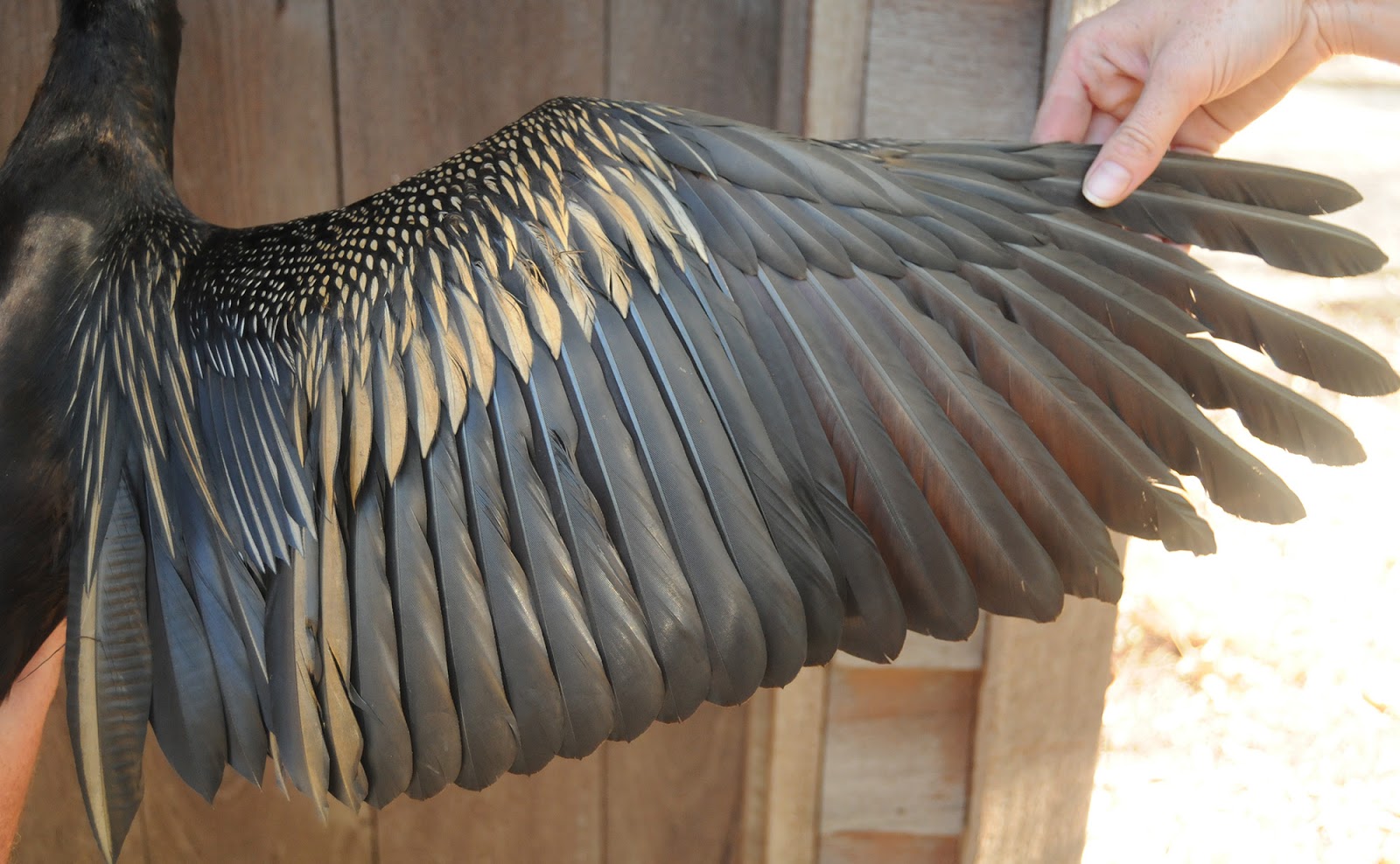
On Saturday the 9th we had more banders available and were able to put up more nets, resulting in a catch of 54 birds! Of particular significance was the Herdsman Lake project's first ever Australasian Darter, which flew into a large-mesh net across the drain. White-winged Triller, Laughing Kookaburra, Grey Teal and Rainbow Bee-eater were also among the 13 species caught on Saturday.
The Silvereye movement was obvious here with only one retrap among 35 new birds. The retrap was from the previous banding session.

White-winged Triller
Australasian Darter. A gentle but firm hold on the birds head is necessary to keep that stunningly sharp bill away from the bander.
Australasian Darter
Close-up of the wing. Interesting to see the corrugated shape of the very long scapular feathers.


Species - New (retrap)
Australasian Darter - 1
Brown Honeyeater - 3
Grey Teal - (1)
Laughing Kookaburra - 1
New Holland Honeyeater - 1
Pacific Black Duck - 1 (1)
Rainbow Bee-eater - 1
Silvereye - 35 (1)
Tree Martin - 1
Weebill - 1
Western Gerygone - 1 (1)
White-winged Triller - 1
Willie Wagtail - 2 (1)
Total - 49 (5) = 54