Saturday, 30 April 2016

Cooling off

The weather has really started to cool down here at Herdsman Lake and, unusually for this time of year, so has the number of birds. The first two banding sessions of April saw 22 and 44 birds caught, and only eight birds were caught on the 23rd of April. This low number was due mostly to less nets being put up because most researchers with the group were off banding at a couple of our regional projects.

The highlights of these sessions included three Little Grassbirds, which we were very lucky to catch in the reed bed, as it won't be long before we can't access that site anymore when it fills with water coming in to winter.

A new Little Grassbird banded in April     Photo: Nick Hart

A new and retrapped Little Grassbird side-by-side. Only subtle differences in plumage were visible, with interesting differences in throat striations to be studied further.
Photo: Nick Hart
Another treat at this time of year is the flocks of Weebills passing through, and we managed to band two. These guys are Australia's smallest bird, weighing in at around 5 - 6.5 g, and banding studies have shown that despite their size they can travel large distances. There has been one record in the eastern states of a Weebill traveling 184 km. Banding studies have also shown that they can live for over 7 years.

The Weebill - Australia's smallest bird    Photo: Nick Hart
Other than that we're excited about the number of Silvereyes we've been retrapping at the lake - this has been very interesting for our study into how Silvereye morphology changes with age.

Banding summary

9th April 2016 - Species, new, (retrap)
Brown Honeyeater 1 (1)
Red Wattlebird 3 (1)
Sacred Kingfisher (1)
Silvereye 4 (3)
Striated Pardalote 4
Weebill 1
Western Gerygone 1
Willie Wagtail 1 (1)

Total 16 + (6) = 22

16th April 2016
Australian Reed-warbler 1
Little Grassbird 2 (1)
Pacific Black Duck 1               
Red Wattlebird 1
Rufous Whistler (2)
Silvereye 24 (6)
Striated Pardalote 2
Weebill (1)
Western Gerygone 2
Yellow-rumped Thornbill 1
 Total 34 + (10) = 44

23rd April 2016
Brown Honeyeater 1
Silvereye 4 (3)
Total 5 + (3) = 8


Lizzy Joyce

Thursday, 7 April 2016

Autumn Movements

We have had poor weather conditions for the last couple of weekends, including being completely rained off last week.

But on April 2nd we had excellent banding conditions and the birds did not disappoint. The large movements of Silvereyes typical of this time of year have started, and these made up the majority of our catch (100 birds, 74 of which were Silvereyes). We controlled one Silvereye from nearby Bold Park, the same bird we controlled in January.
This session also marked a significant milestone where we surpassed a total of 7000 Silvereyes banded over the course of the Herdsman Lake Project.

An unusually bright-yellow Silvereye (right) compared to a 'normal' coloured Silvereye (left)

No waterbirds this week, however we still banded a couple of larger birds in the form of an Australian Raven and an Australian Hobby.

Australian Raven. Note the brown eye in this young bird. Adults have a white iris.
Australian Hobby
The highlight of the day was a most unexpected Western Spinebill, only the sixth ever banded at Herdsman Lake. It was a young bird and probably just passing through, as we tend to see in species like White-cheeked Honeyeater at Herdsman.

First-year Western Spinebill

Species - new (retrap) [control]
Australian Hobby - 1
Australian Raven - 1
Australian Reed-warbler - (2)
Brown Honeyeater - 6 (2)
New Holland Honeyeater - 1
Red Wattlebird - 2
Rufous Whistler - 1
Silvereye - 68 (5) [1]
Singing Honeyeater - 1 (1)
Striated Pardalote - 1 (1)
Western Gerygone - 3
Western Spinebill - 1
Willie Wagtail - 1 (1)
Total - 87 (12) [1] = 100

Monday, 14 March 2016

Mid-March Mist-netting

12 March 2016
We had enough people to run a good variety of nets this weekend and this gave us a diverse catch. The highlights were four first-year Black-faced Cuckooshrikes in the same net. This is a rather spectacular figure given that the previous total banded was just 11 over 15 years at Herdsman!

First-year Black-faced Cuckooshrike
A trio of Black-faced Cuckooshrikes

Silvereyes and Striated Pardalotes were both present in good numbers. The pardalotes were all first-year birds and most of the Silvereyes that we were able to age were also first-years.


The Inland Thornbill we caught recently was recaptured this weekend in the same area.

Inland Thornbill
Adult (age 2+) Australian Reed-warbler
 
Species - new (retrap)
Australian Reed-warbler - 2
Black-faced Cuckooshrike - 4
Brown Honeyeater - 1
Grey Teal - 1
Inland Thornbill - (1)
Pacific Black Duck - (2)
Rufous Whistler - 1
Silvereye - 19 (1)
Singing Honeyeater - 1
Striated Pardalote - 15
Western Gerygone - 1 (1)
Willie Wagtail - 3 (1)
Total - 48 (6) = 54

Monday, 7 March 2016

Breaking Records in February

Apologies for the lack of recent posts. Here are the last three weeks of banding at Herdsman!

20 Feb 2016
This weekend was rather slow and we only processed four species during the Saturday morning. Surprise numbers of Striated Pardalotes made up for the low numbers of Silvereyes.

Species - New (retrap)
Pacific Black Duck - 1 (1)
Silvereye - 6
Striated Pardalote - 12
Willie Wagtail - 2 (1)
Total - 21 (2) = 23


27 Feb 2016
This Saturday made for an exciting February banding session. We caught good numbers of Silvereyes including 10 recaptures. Many of the Silvereyes first caught in December/January in juvenile plumage are now moulting or have finished moulting into adult dress and are difficult to distinguish from older birds.
A smattering of Australian Reed-warblers was a welcome addition, as was an Inland Thornbill, only the third ever for the Herdsman project.

On another note, for the first time ever the catch exceeded 1000 birds before March (our 'banding year' starts in July and runs until the end of the following June). The total came to 1028 birds on our last banding session for February.

Species - New (retrap)
Australian Reed-warbler - 6
Brown Honeyeater - 1
Inland Thornbill - 1
Pacific Black Duck - 1
Rufous Whistler - 3
Silvereye - 18 (10)
Singing Honeyeater - (1)
Striated Pardalote - 9
Western Gerygone - (1)
Total - 39 (12) =51


5 Mar 2016
Birds were not particularly numerous this weekend (not unusual for the time of year) however we did have a particularly diverse catch this time. 19 birds of an amazing 12 species were processed, highlights being an Australian Magpie, Australian Raven and Magpie-lark which all came from the same net.
Silvereyes were few and far between but we caught a variety of honeyeaters, which have been notable in their absence recently.

Adult Australian Raven
Adult female Australian Magpie
Species - New (retrap)
Australian Magpie - 1
Australian Raven - 1
Brown Honeyeater - 2
Laughing Dove - 1
Magpie-lark - 1
Red Wattlebird - (1)
Silvereye - (2)
Singing Honeyeater - 1
Striated Pardalote - 1
Western Gerygone - 2
Willie Wagtail - 2 (1)
Yellow-rumped Thornbill - (3)
Total - 12 (7) = 19

Sunday, 14 February 2016

February

The first two banding sessions for February were not as dazzling as January when we were processing 100 birds a morning, however over 30 birds on both mornings was not a disappointing catch.

Nets in the reed bed produced Australian Reed-warblers and most of the other birds came from nets in the grove. The large flocks of Silvereyes seem to have passed through and now Striated Pardalote and Willie Wagtail numbers match the Silvereyes.

One first-year Willie Wagtail had unusual primary moult where it had replaced primaries 5 and 7, and was in the process of replacing P3, but the rest were old feathers. Very different to the usual inside-to-outside, sequential pattern you usually see in passerines.

Willie Wagtail primary moult.

 A flock of 50+ Rainbow Bee-eaters was hanging around but hesitant to come low enough for our nets. Finally there was a surprise reappearance by the White-browed Scrubwren we banded a few weeks ago.

First-year Yellow-rumped Thornbill.


6 Feb 2016
Species - New (retrap)
Australian Reed-warbler - 3
New Holland Honeyeater - 1
Silvereye - 11 (1)
Striated Pardalote - 6
Western Gerygone - 1
Willie Wagtail - 5 (3)
Yellow-rumped Thornbill - (1)
Total - 27 (5) = 32

13 Feb 2016
Species - New (retrap)
Australian Reed-warbler - 4
Grey Fantail - 2
Rainbow Bee-eater - 1
Rufous Whistler - 1 (1)
Silvereye - 5 (2)
Striated Pardalote - 6
Western Gerygone - 2 (1)
White-browed Scrubwren - (1)
Willie Wagtail - 8 (3)
Yellow-rumped Thornbill - (1)
Total - 29 (9) = 38

Monday, 1 February 2016

January Wrap-up

Saturday the 30th was the last banding day for January this year, and an excellent month it was. The total catch for the month was 363 birds, only 16 short of the January record.

On the 30th we managed to just crack the 100 bird mark with 103 birds processed, comprised mostly of Silvereyes and Striated Pardalotes. Once again the vast majority of Silvereyes were in their first year and the pardalotes were the same. These birds all came out of six nets, as Settler's Cottage was being used during the morning and we were exiled to the Grove. Two Australian Reed-warblers were also caught, a nice surprise outside of the reed-bed, as well as two juvenile Rainbow Bee-eaters.

We caught a single male Variegated Fairy-wren which was a retrap. Interestingly it was first banded on the same day as last week's female Variegated Fairy-wren retrap, 7th July 2012.

Male Variegated Fairy-wren

Species - New (retrap) [control]
Australian Reed-warbler - 2
Grey Fantail - 1
New Holland Honeyeater - 1
Rainbow Bee-eater - 2
Silvereye - 60 (2) [1]
Striated Pardalote - 25
Variegated Fairy-wren - (1)
Western Gerygone - 1
Willie Wagtail - 1 (4)
Yellow-rumped Thornbill - 1 (1)
Total - 94 (8) [1] = 103

Saturday, 23 January 2016

Silvereye Season

The day started off poorly as we discovered that all of the paths leading to the mound (our most regular net site) were closed off. So we ran just six nets in the Grove and one duck net over the drain, and then good things happened!

A Little Pied Cormorant was the only bird caught in the duck net and it was a retrap from 7 months ago when it was age 1. The bird had appeared to have an unusual style of primary moult (although perhaps not unusual in cormorants) starting from approximately P4/5 and continuing in both directions from that point. Our bird was near the end of moult with P1 and P9 growing.

Little Pied Cormorant
Despite having relatively few nets up, we had the largest catch of the year so far; 94 birds.
The first bird of the morning was a female Variegated Fairy-wren, banded in winter 2012.

The vast majority of these were Silvereyes and we were pleased to control two birds from nearby Bold Park in the mix (identified by red colour bands which are used at Bold Park). These were both first-year birds so quite likely joining in the mass movement of young Silvereyes through Perth. The other 71 Silvereyes were mainly young birds and only two were retraps.

One of the Silvereyes from Bold Park
A young White-browed Scrubwren was caught later in the morning, which is a very unusual bird for Herdsman Lake. I remember catching one a year or two ago and it stayed in the area for a few weeks (we retrapped it a couple of times) before moving elsewhere.

White-browed Scrubwren
Species - New (retrap) [control]
Brown Honeyeater - 2
Grey Fantail - 1
Little Pied Cormorant - (1)
Silvereye - 69 (2) [2]
Striated Pardalote - 3
Variegated Fairy-wren - (1)
White-browed Scrubwren - 1
Willie Wagtail - 11 (1)
Total - 87 (5) [2] = 94

More Than Just a Hobby

16th of January: Another hot day with an early finish, however this didn't seem to deter the birds. Tree Martins were flying low in large flocks and we managed to get 20 of these gorgeous birds in the mound nets, as well as an Australian Hobby later in the morning! Other than the martins, numbers were fairly low compared to recent weeks however it all averaged out to a good catch of 48 as we had a staggering 16 species.
Other highlights were Shining Bronze-cuckoo, Rainbow Bee-eater juveniles, Grey Teal and Laughing Kookaburra. Surprisingly we only caught 4 Silvereyes.

Australian Hobby

Species - New (retrap)
Australian Hobby - 1
Brown Honeyeater - 1
Grey Teal - 2
Laughing Kookaburra - 1
Pacific Black Duck - 1
Rainbow Bee-eater - 3
Red Wattlebird - 1
Rufous Whistler - 3
Sacred Kingfisher - 2
Shining Bronze-cuckoo - 1
Silvereye - 2 (2)
Striated Pardalote - 2 (1)
Tree Martin - 20
Western Gerygone - (1)
Willie Wagtail - 3
Yellow-rumped Thornbill - (1)
 Total - 43 (5) = 48

Saturday, 9 January 2016

First banding of 2016

Despite high temperatures, the first couple of banding sessions of 2016 (6 and 9 January) were excellent. Silvereyes are starting to move through again and most of these are first-year birds. We are getting very few recaptures of the Silvereyes that were resident during Oct-Nov last year.

On Wednesday the 6th we caught 25 birds including Grey Teal, Sacred Kingfisher and Tree Martin. A young Horsfield's Bronze-cuckoo (the first since 2013) was the highlight.

Juvenile Horsfield's Bronze-cuckoo showing the dark ear-stripe and rufous tail.
Horsfield's Bronze-cuckoo

Species - New (retrap)
Brown Honeyeater - (1)
Grey Teal - 2
Horsfield's Bronze-cuckoo - 1
Laughing Dove - 1 (1)
Pacific Black Duck - 1 (1)
Rufous Whistler - (1)
Sacred Kingfisher - (1)
Silvereye - 5 (1)
Singing Honeyeater - 4
Tree Martin - 1
Willie Wagtail - 3
Yellow-rumped Thornbill - 1
Total - 19 (6) = 25


On Saturday the 9th we had more banders available and were able to put up more nets, resulting in a catch of 54 birds! Of particular significance was the Herdsman Lake project's first ever Australasian Darter, which flew into a large-mesh net across the drain. White-winged Triller, Laughing Kookaburra, Grey Teal and Rainbow Bee-eater were also among the 13 species caught on Saturday.
The Silvereye movement was obvious here with only one retrap among 35 new birds. The retrap was from the previous banding session.

White-winged Triller
Australasian Darter. A gentle but firm hold on the birds head is necessary to keep that stunningly sharp bill away from the bander.
Australasian Darter
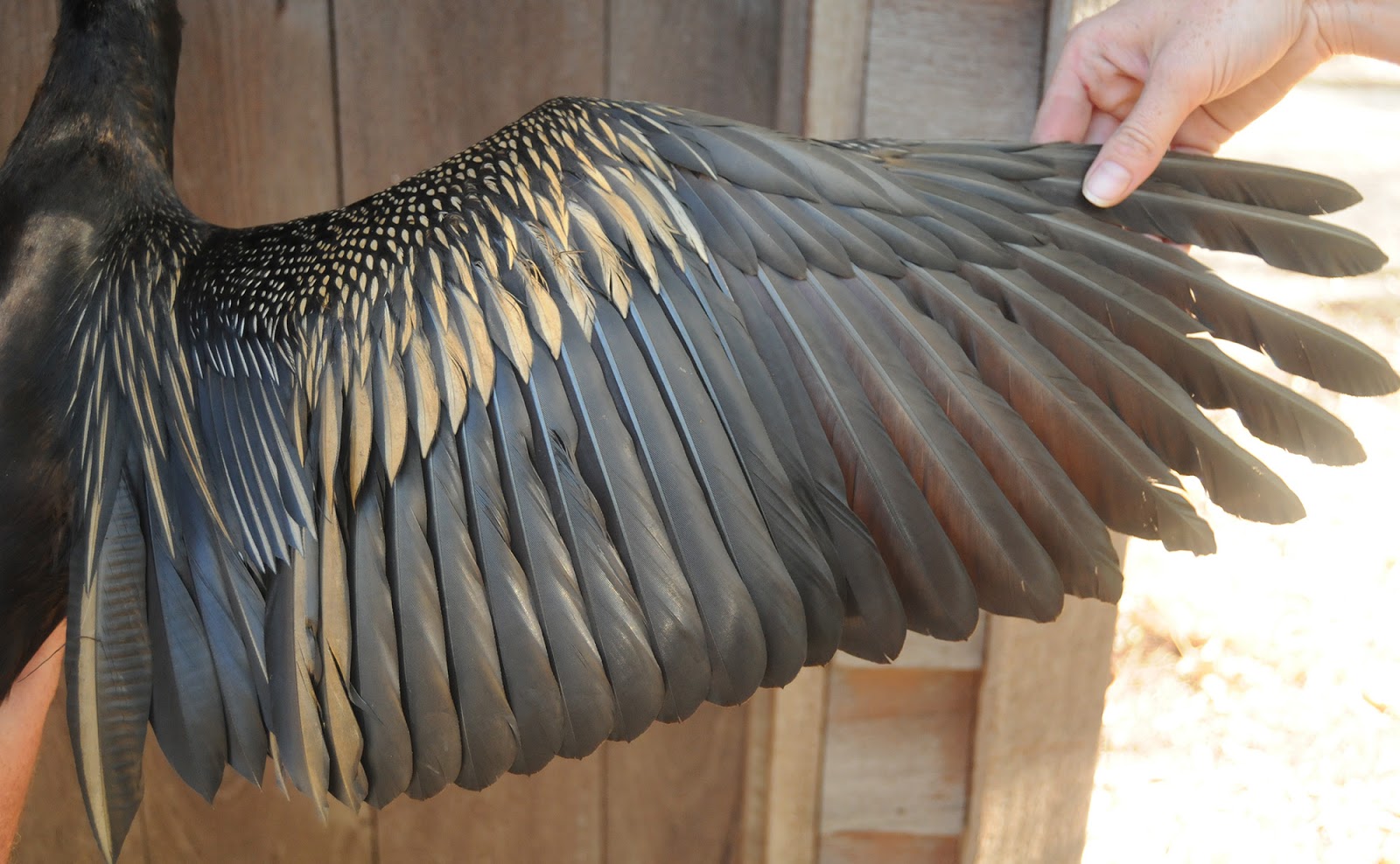
Close-up of the wing. Interesting to see the corrugated shape of the very long scapular feathers.


Species - New (retrap)
Australasian Darter - 1
Brown Honeyeater - 3
Grey Teal - (1)
Laughing Kookaburra - 1
New Holland Honeyeater - 1
Pacific Black Duck - 1 (1)
Rainbow Bee-eater - 1
Silvereye - 35 (1)
Tree Martin - 1
Weebill - 1
Western Gerygone - 1 (1)
White-winged Triller - 1
Willie Wagtail - 2 (1)
Total - 49 (5) = 54

Saturday, 28 November 2015

Late November

After last week's 28 birds we went banding with a spring in our step (or we would have, if it wasn't 4am at the time) and managed to catch another 28 birds this weekend on the 28th of November. We had a load of interesting things to keep us busy throughout the morning.

The morning started strong with a Red Wattlebird and only our second Australian Reed-warbler of the season. 

The Reed-warbler was aged as a 2 (in its second year of life) due to the condition of the feathers especially the tail, and the colour of the bird.
The plumage overall was fairly heavily worn, especially the central tail feathers (rectrices). These central rectrices are the last vestiges of the bird's juvenile plumage which was attained when it left the nest during the breeding season last year. At the end of that breeding season the bird underwent a partial post-juvenile moult, excluding the central rectrices. It has gone for most of a year in this plumage so looks well worn, however it has had the central rectrices for over a year and they are noticeably more worn.
Because is still has the juvenile feathers we can say it was born last year so is over 12 months old (age 2).

Australian Reed-warbler age 2.
The central pair of tail feathers are heavily worn - retained from juvenile plumage most of which was replaced during the post-juvenile moult (as seen in the rest of the tail feathers).

The duck net was productive as usual and it caught Pacific Black Duck, Grey Teal and a very uncommon bird for the Herdsman Lake project - Australian Ringneck.
Parrots are always a delight to extract from waterbird mist nets nets as the mesh is large enough for the bird's head to go through and you have to somehow hold onto its head to avoid getting bitten and simultaneously get the net off the angry parrot's head. It was worth the hassle; I don't have access to the data right now but we've only banded a handful of Ringnecks at Herdsman over the years.

Parrots usually don't present well for photos as you need a constant grip on the head, but this wing was too beautiful to miss. Here it shows an unusual primary moult pattern, Staffelmauser or stepwise moult, with two sections of primaries being moulted simultaneously.

A Purple Swamphen managed to find its way into a small-mesh mist net and we were lucky enough to reach it before it escaped. Other birds through the day included a smattering of passerines and five retrapped Yellow-rumped Thornbills which made for some good comparisons of older and younger birds.

Yellow-rumped Thornbills adult age 2+ (left) and juvenile (right). The adult bird was in moult and showed new and old adult-style feathers. The juvenile had a well-marked crown for its age, but the feather shape and tail pattern indicated a juvenile.
Tails of Yellow-rumped Thornbills adult age 2+ (left) and juvenile (right). Note the strong demarcation between white and black on the outer tail feather of the adult compared to the weak demarcation on the juvenile's outer tail feather.

On a final happy note the Willie Wagtail pulli that we banded last week are growing fast and looking very big! They were very active, standing up in the very crowded nest and begging for food from the parents.
The next morning they had fledged!

Willie Wagtail fledglings. Photo by Jennie Stock
Fledgling being fed by one of its parents. Both parents are also banded! Photo by Jennie Stock


Species - New (retrap)
Australian Reed-warbler - 1
Australian Ringneck - 1
Brown Honeyeater - 2
Grey Teal - 1
Pacific Black Duck - 2
Purple Swamphen - (1)
Red Wattlebird - 1
Rufous Whistler - (1)
Silvereye - 5 (5)
Singing Honeyeater - 1
Willie Wagtail - 2
Yellow-rumped Thornbill - (5)
Total - 16 (12) = 28

Friday, 27 November 2015

Wagtail Nestlings and Whistlers

 At last a morning that broke the 20 birds mark! That doesn't sound like much of an achievement but the last half-dozen sessions yielded less than that.

The duck net caught three of a family of five Australian Wood Ducks, including both parents. A Grey Teal was caught late in the morning.

Despite the wind the rest of the nets kept up a steady trickle of birds including Grey Fantail, Yellow-rumped Thornbill and two Rufous Whistlers.

Adult female Rufous Whistler. Note the all black bill and the red eye. The streaking on the throat is not well shown in this picture, but is not as dark and thick as juvenile birds.
The back of the female whistler. Tail shape is an important character in ageing these birds - this one had broad, round-tipped feathers typical of adults.
We had a rare opportunity to band some Willie Wagtail pulli (nestlings). Willie Wagtails have a tendency to nest in strange places and this was no exception - in a tree right next to the public footpath and within arm's reach from the ground.
Looking at the nestlings we could see that they were at the perfect age to be banded. That is, when the feathers have just started emerging from their sheaths. Before this the birds are too small, and much later than this the birds are big enough to try and leave the nest. The three pulli were quickly banded and the parents were happily attending to them the next time I walked past.
This was also a good learning experience for our trainee banders as we don't get to band nestlings often at Herdsman.

The growing feathers have just broken tips of the feather sheaths - the perfect age for pullus banding.
Willie Wagtail pulli, ready to be banded.


Species - New (retrap)
Australian Wood Duck - 3
Brown Honeyeater - 1 (1)
Grey Fantail - (1)
Grey Teal - 1
New Holland Honeyeater - (2)
Rufous Whistler - (2)
Silvereye - 4 (5)
Willie Wagtail - 3
Yellow-rumped Thornbill - (4)
Total - 12 (15) = 28

Thursday, 19 November 2015

Quiet November Banding


Another quiet November Saturday. The temperature quickly rose past 30 degrees, heading for a maximum of 38, so banding was finished by 9am.

Two of the Silvereye retraps were first encountered in 2009 and in 2010. The Grey Fantail, Yellow-rumped Thornbill, New Holland Honeyeater and some Silvereyes were all first-year birds.

Juvenile Grey Fantail
Yellow-rumped Thornbill in first year.
Note the grey eye, dull spots on the forehead and contrast in colour between the old and new (growing) tail feathers.
 Some of us (mainly me) were kept entertained by a caterpillar doing a rather convincing imitation of a leaf petiole. The trick worked well when it was sitting on a stick, rather than the end of my finger!


Species - new (retrap)
Grey Fantail - 1
New Holland Honeyeater - 1
Pacific Black Duck - 1 (1)
Silvereye - 4 (4)
Willy Wagtail - (1)
Yellow-rumped Thornbill - 1
Total - 8 (6) = 14

Friday, 13 November 2015

Early November

November started with little fanfare or excitement on the banding front. Two banding trips were both very quiet, with the exception of two Laughing Kookaburras caught in the reed bed which loudly expressed their distaste of the situation.

Only one bird on Wednesday was a new bird - the rest were all recaptures, even the duck and the kookaburras.

Laughing Kookaburra


Wed 4/11
Species - new (retrap)
Laughing Kookaburra - (2)
Pacific Black Duck - (1)
Silvereye - 1 (3)
Total - 1 (6) = 7

Sat 7/11
Species - new (retrap)
Brown Honeyeater - 1
Pacific Black Duck - 1
Silvereye - 2 (2)
Striated Pardalote - 1
Western Gerygone - 1 (1)
Yellow-rumped Thornbill - (2)
Total - 6 (5) = 11

Tuesday, 3 November 2015

Reed Bed Ringing

On the last day of October we attempted to best our record October catch at Herdsman. We needed just over 50 birds to do so and hopes were high after catching so many during the last few weeks. Alas, it was not to be and we only caught a handful of birds despite our best efforts.

The usual nets on the mound were not put up due to nesting bee-eaters and the bottlebrush trees in the car park were finished flowering, so produced few birds. No Red Wattlebirds were caught; surprising after catching so many less than a week ago.

We used the quiet morning to reinstate the reed bed nets after a lengthy break where the water level was too high. The reed bed was much drier than anticipated and few birds were caught there, but we did catch our first Australian Reed-warbler for the year.

Australian Reed-warbler adult (age 2+)

Of particular interest this week was a Silvereye retrapped during the banding demonstration on Wednesday. Checking the records showed that the bird was originally banded in November 2006, almost 10 years ago! An exceptional bird falling slightly short of the time-elapsed record for a Silvereye at Herdsman Lake.

Species - new (retrap)
Australian Reed-warbler - 1
Brown Honeyeater - 1
Laughing Dove - 1
Shining Bronze-cuckoo - (1)
Silvereye - 3 (3)
Striated Pardalote - 1
Western Gerygone - 1
Total - 8 (4) = 12

Monday, 2 November 2015

Churchlands Primary School Banding Demonstration


We had a great day on Wednesday giving a banding demonstration to the Pre-Primary and Kindy kids of Churchlands Primary School. As the school is right across the road from Herdsman Lake this was a fantastic opportunity for the kids to learn about the birds in their local environment and the importance of Herdsman Lake in the Perth area, as well as see some of the smaller bush birds up close. We managed to catch a Silvereye, Yellow-rumped Thornbill and New Holland Honeyeater to show which the kids loved. A large focus of the talk was on working scientifically. The classes learned about the aims of the Australian Bird and Bat Banding Scheme and we showed how we conduct our research at the lake by applying a band to the bird's leg and demonstrating how we take all the measurements and record data. Some lucky kids even got the chance to help release a bird back into the bush. The day was a success all round, and hopefully we inspired some budding ornithologists to grab some binoculars and get out there!

Showing the wing and moult
of a New Holland Honeyeater

Too big for a Honeyeater - showing the
different sizes of bands

Releasing a Silvereye

Photos: Calan Rance


"Dear Lizzie, Thankyou for showing
nearly all the birds, and we saw a
 Bee-eater hole and for teaching
...how to measure its fat
."
"Dear Lizzie, Thankyou for showing us the birds
they are so cute and looked so cuddly.
I like the Silvereye bird the most. I also
 loved when you measured its head
."

Earlier in the morning before the classes arrived we still conducted a normal banding session and had a slow but steady October catch. The highlight of the morning was another Bee-eater (with interesting tail moult leading us to age it as a 2-), which was unfortunately just that bit too early for the kids to see.

Tail of a 2- Rainbow Bee-eater

Breakdown  28/10/2015:

Silvereye: 4 new, 7 retraps
Singing Honeyeater: 1 new
New Holland Honeyeater: 1 new
Yellow-rumped Thornbill: 2 new, 1 retraps
Rainbow Bee-eater: 1 new
Laughing Dove: 1 retrap
TOTAL: 9 new + 9 retrap = 18